
With less than six months left for this financial year and poor response from applicants, launching the scheme this year is unlikely.

India's leading agriculture commodity exchange, the National Commodity & Derivatives Exchange (NCDEX), has decided to acquire around a 20 per cent stake in a new commodities and financial derivatives exchange being set up in Sri Lanka, subject to regulatory and governmental approvals. The move aims to deepen NCDEX's footprint in the financial ecosystem of its neighbouring country.

Supply chains are evolving from operational backbones to strategic growth enablers for organisations, though they remain underleveraged and struggle for recognition at the executive level, a report by PwC India said. The survey highlighted that recent developments in the trade and tariff landscape represent both a stress test and a strategic inflection point for supply chains.

The reduction in the number of loan accounts and the outstanding amount during the last financial year is a cause of concern and stress for microfinance institutions (MFI), Secretary, Department of Financial Services, M Nagaraju said on Thursday, highlighting "inefficiency" in MFIs that leads to higher rates of interest.

The ministries of Road Transport & Highways and Railways have exceeded the national average capital expenditure (capex) by spending 63 per cent and 57 per cent of Budget estimates (BE), respectively, in the first half of 2025-26 (FY26). The total capital expenditure for April-September of FY26 stood at 52 per cent of the BE, according to the latest data by the Controller General of Accounts (CGA).

IBBI removes sale of company as going concern in liquidation; now only asset sales allowed, shifting focus strictly to terminal liquidation process.

Clarity on Tata Sons' position on listing, as of 2025, would help define the future of the group better, irrespective of the RBI stand. As of now, the ball is in the RBI's court, and everyone is watching the space, points out Nivedita Mookerji.

The record monsoon rains across India during the June to September months was 937.2 millimetres, the 5th-highest since 2001 and 38th-highest since 1901.


India needs to limit its reliance on multinational corporations (MNCs) for strategic audits and consulting in order to strengthen its economic sovereignty and achieve the goal of Atmanirbhar Bharat, the Ministry of Corporate Affairs (MCA) said in an office memorandum released on Wednesday.

'It was like rigorously preparing for a solid, good exam...' 'I don't know what marks I will get, but I felt the rigorous preparation of an exam.' 'You may sweat, but I feel rejuvenated.'

'I am doing the drive in making sure that people pass this on. So the drive is not with distrust. The drive is just in case.' 'Just in case it doesn't get passed on, I am here.'

'That is going to have an impact on literally every one, whether you buy a toothpaste, a safety pin, a car, shoes or medicines or you go to a diagnostic centre.'

The demand growth in the low-income category is expected to be driven mainly by packaged branded sugar as well as traditionally consumed gur (jaggery) and khandsari.

IMD data shows in the 24 hours between September 1 and 2, Haryana received 806 per cent more rainfall than normal, Punjab 759 per cent, Himachal Pradesh 510 per cent, Delhi 740 per cent, Chandigarh a staggering 1,638 per cent, and Rajasthan 193 per cent.

'I can sanction projects worth Rs 20 trillion annually as of today.' 'But my system is only capable of executing projects worth Rs 3 trillion to Rs 4 trillion.'

IPOs have been the flavour of the season for some time. But the coming together of three mega IPOs, from diverse businesses and historic relevance, could tell a story that's still in the making, points out Nivedita Mookerji.

Maharashtra has topped the list of states with the most favourable ecosystem for the growth of Farmer Producer Organisations (FPOs), replacing Madhya Pradesh, which has slipped to second place, according to the latest Ease of Doing Business for FPOs (EoDBF) ranking.

The 50 per cent US tariff on Indian goods pose a downside risk to growth but the impact is expected to be short-lived for the economy, and consumption demand could see an uptick after the new goods and service tax (GST) rates are implemented which could even offset the external uncertainty, Chief Economic Advisor (CEA) V Anantha Nageswaran reckoned on Friday.
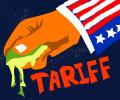
'If the near-term economic pain is absorbed more by those who have the ability and the financial strength to do so, then small and medium enterprises in downstream industries will emerge stronger from the trade imbroglio.'
 © 2026 Rediff.com - Advertise with us - Disclaimer - Privacy Policy - Sitemap - Feedback - About us - Terms of use - Grievances